Gauhati University Student Builds Digital Platform to Connect Flood Victims with Relief Providers
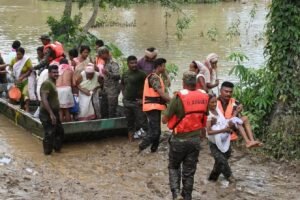
As relief convoys continue to reach flood-ravaged districts of Upper Assam, a Gauhati University student has found a different way to support the humanitarian effort—by using technology to connect people willing to provide assistance with communities urgently seeking help.
B.Tech student Tinku Moni Kaushik was unable to travel to the flood-affected districts because of an ongoing internship. Instead, he decided to use his technical skills to contribute to the relief operation, leading to the creation of Axom Relief, a digital platform designed to bridge the gap between relief providers and flood-hit communities.
Kaushik is currently interning with the Directorate of Information Technology, Electronics and Communication, Assam. He said the idea came to him while watching relief activities and appeals for assistance unfold across social media.
Unable to join his friends on the ground, Kaushik felt he could contribute through technology. Social media was filled with people asking where they could send relief materials, while others were posting details about villages that were still waiting for assistance.
The platform was developed with the aim of bringing both groups together in one place—those looking to provide relief and those who need it.
Kaushik subsequently approached software engineer Ankita Bhagawati with the idea. Bhagawati took up the development work and brought interface designer Mrigakshee Krishnatreya and other members of the technology community into the project.
The team worked against the clock. The concept was shared on July 29, and within the next 24 hours, the members designed, developed and tested the website, registered a domain and launched Axom Relief at around 2 am on July 30.
Bhagawati said the website took roughly 12 hours to develop, including prototype design and coding. While AI tools were used to assist with portions of the coding, the overall architecture and system design were developed manually, she said.
However, the team’s biggest challenge was ensuring that the platform remained usable in flood-affected areas where internet connectivity can be unreliable.
The developers therefore kept the interface deliberately simple and avoided features such as OTP-based verification that could make access difficult in low-connectivity areas.
According to Bhagawati, the objective was to create a platform that could function even where network availability was limited.
Kaushik said the platform could also be used by people in neighbouring villages to help relief teams identify and reach locations that remain inaccessible. Local residents could potentially provide directions and information about areas where internet connectivity is unavailable.
The initiative has already received a positive response. More than 300 relief providers and around 140 people seeking assistance have reportedly registered on the platform so far.
The project has also attracted the attention of the Sivasagar district administration. Bhagawati said officials interacted with the team and suggested additional features, including administrative access, which could help authorities coordinate relief and rescue activities more efficiently.
For the moment, the team does not plan to develop a dedicated mobile application because of financial limitations. Kaushik said the website is currently sufficient to meet the immediate requirement and there is not enough funding to develop and publish an application on the Play Store or App Store.
Apart from Kaushik, Bhagawati and Krishnatreya, the project team includes Tonmoy Mahanta and Nikumoni Borah.
At a time when timely and accurate information can be just as crucial as physical relief supplies, Axom Relief has emerged as an example of how technology and community initiative can complement traditional relief operations.
The effort demonstrates that during a humanitarian crisis, helping people does not always require being physically present at the disaster site—sometimes, a simple idea, technical knowledge and the determination to act can also make a difference.