Cosmic Archaeology NASA’s Webb Telescope Unveils Hidden Scars of Ancient Galaxy Crash in Centaurus A
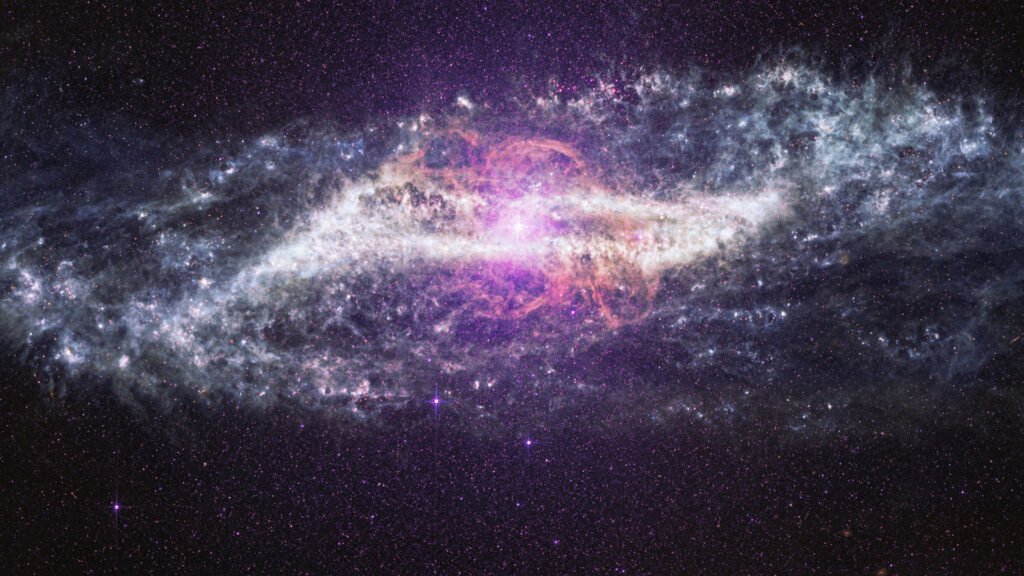
To celebrate its fourth year of science operations, NASA’s James Webb Space Telescope (JWST) has released a spectacular, hyper-detailed image of Centaurus A, a unique galaxy located roughly 11 million light-years away from Earth. While Centaurus A has been a frequent target for astronomers since its discovery in 1826, its innermost secrets have historically remained hidden behind a thick, impenetrable blanket of dark cosmic dust that blocked the visible light observations used by the Hubble Space Telescope. Utilizing its advanced Mid-Infrared Instrument (MIRI) and Near-Infrared Camera (NIRCam), Webb has successfully pierced through this cosmic haze, exposing the intricate, warped structures left behind by a massive collision between two distinct galaxies that occurred roughly two billion years ago.
The unprecedented infrared data has provided European Space Agency (ESA) and NASA astronomers with a clear look at the chaotic inner workings of the galaxy’s core, which features a vibrant, glowing dust landscape twisted into a bizarre parallelogram shape alongside a distinct S-shaped feature. These glowing regions are packed with dense stellar nurseries and aging stars fueled by the ancient merger, which injected an abundance of raw gas and dust into the system. Furthermore, Webb’s high-resolution instruments allowed scientists to track the motion of ionized gas swirling around and blasting away from the supermassive black hole at the center of Centaurus A. This observations reveal a complex, dual relationship showing how the black hole simultaneously compresses gas to trigger intense new star formation while violently purging the vital materials needed for star birth—essentially reshaping the galaxy’s long-term evolution.